Living room
Frame tops → shelves → lamps → tables → upholstery → baseboards → floor
Decor, electronics, fabric shades, and open shelving need tool-specific care.
Whole-home care guide
A calm ceiling-to-floor method for shelves, decor, textiles, edges, and the final floor pass—plus a clear answer to whether you should dust or vacuum first.
See the MethodThe short answer
Dust a house from the highest reachable surfaces down, using a clean microfiber cloth that captures particles; vacuum or mop the floor last.
The order matters because surface work can send settled dust downward. A final floor pass collects what falls instead of making you clean the same area twice.
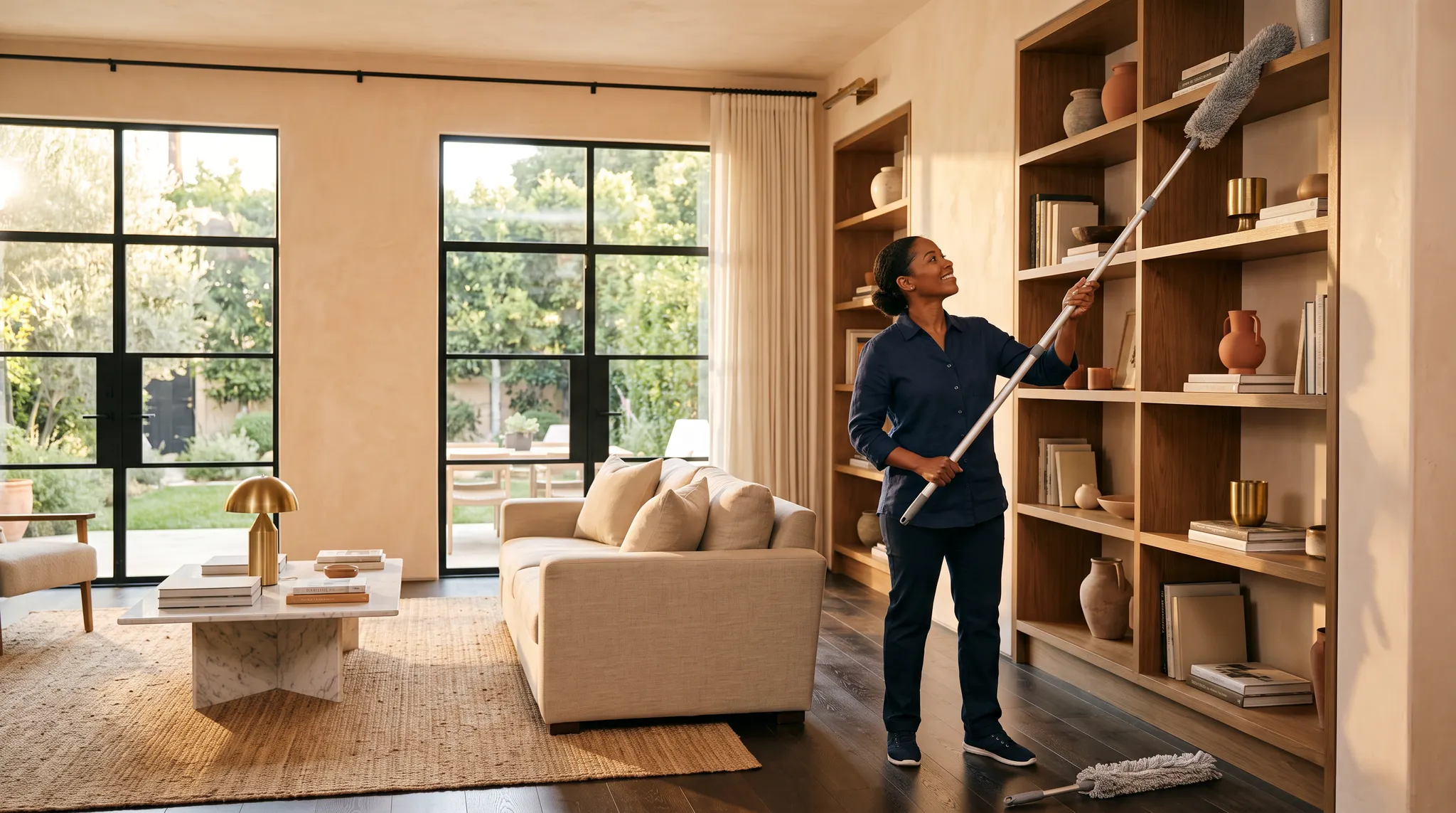
Treat the room as a vertical route, not a collection of random objects. One controlled pass from high surfaces to the floor is easier to repeat and easier to check.
Build Your KitOpen a safe path, gather a clean microfiber cloth, a surface-appropriate duster, and a vacuum with the right attachments. Put away fragile pieces you do not want handled.
Begin with reachable vents, upper shelves, frame tops, molding, and light fixtures that can be cleaned safely from the floor. Do not improvise on unstable furniture or reach beyond a secure position.
Work across shelves, tables, lamps, electronics, and decor. Lift small objects deliberately, wipe the surface beneath, and return them only when the area is clean and dry.
Use the correct vacuum attachment on upholstery, fabric shades, and accessible edges. Give baseboards, sills, door tops, and furniture undersides a separate pass instead of treating the room as one flat plane.
Do not treat every fabric shade as vacuum-safe. Check our fabric lampshade care guide for low-suction limits, delicate pleats, and washing instructions.
Vacuum rugs, carpet, upholstery, and hard-floor edges after surface work. Mop only with a method suitable for the floor, then clean or launder reusable tools before the next room.
Room map
Keep the high-to-low logic, then adapt the route to the materials and objects in front of you. Check care labels before adding moisture or product.
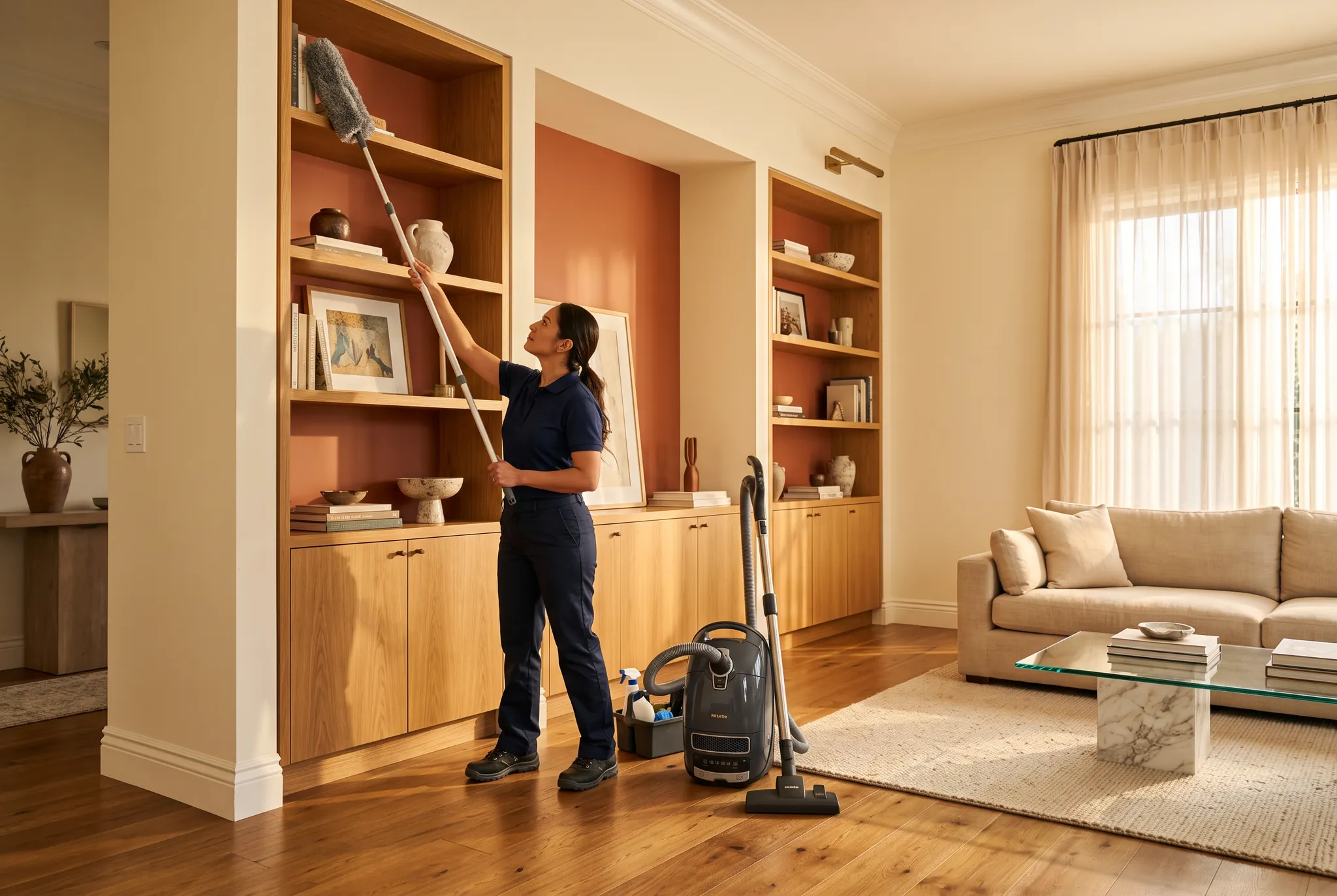
Frame tops → shelves → lamps → tables → upholstery → baseboards → floor
Decor, electronics, fabric shades, and open shelving need tool-specific care.
Headboard → nightstands → dresser → sills → under-bed edge → floor
Handle bedding and textiles separately; avoid shaking dusty linens in the room.
Upper ledges → cabinet faces → small appliances → counters → toe-kicks → floor
Dry dust first, then use a surface-safe kitchen method where grease has bound dust in place.
Vent cover → light → mirror top → shelving → fixtures → baseboards → floor
Remove loose dust before spraying so particles do not turn into wet residue.
Routine room: dust high and middle surfaces, detail edges and textiles, then vacuum or mop.
Floor with large debris: pick up the pieces first so you do not kick them around, then dust, then complete the final floor pass.
Multi-room clean: finish one room at a time or complete the same height across adjacent rooms before moving down.
Why the method works
The U.S. EPA recommends frequent cleaning, dusting with a damp cloth, and considering a HEPA-filter vacuum to reduce dust buildup and limit particles escaping back into the air.
The American Lung Association also recommends a damp mop, damp cloth, or a duster designed to trap dust, with extra attention to baseboards, molding, blinds, and shelves.
La La Land Cleaning connects Los Angeles clients with independent cleaning professionals. Reachable-surface dusting can be discussed as part of standard or recurring cleaning; tall ledges, delicate collections, blinds, ceiling fans, heavy buildup, and specialty surfaces should be confirmed before the visit.
Inside-appliance cleaning and interior glass are add-ons, not automatic parts of a routine visit.
Dusting FAQ
Straight answers about order, tools, timing, professional scope, and indoor-air considerations.
For routine whole-room cleaning, dust higher surfaces first and vacuum or mop the floor last. That final floor pass collects particles that fall while you work. If the floor has large debris, pick it up first, then dust, then complete the final vacuum.
Use a clean microfiber cloth or another tool designed to capture dust rather than scatter it. The EPA recommends dusting with a damp cloth because light dampness helps keep settled dust from returning to the air. Always follow the care instructions for the surface.
Work slowly from high to low, fold the cloth to expose a clean face, and avoid snapping or shaking dusty textiles indoors. Use a vacuum attachment where appropriate, then finish the room with a filtered vacuum pass on floors and upholstery.
There is no single schedule for every home. Traffic, open windows, pets, textiles, nearby construction, and household sensitivities all change how quickly dust returns. Dust visible buildup and use a repeatable weekly or biweekly rhythm for the rooms that collect it fastest.
Yes. Reachable-surface dusting is commonly part of routine residential cleaning, but the exact checklist varies. Confirm tall ledges, delicate collections, blinds, ceiling fans, heavy buildup, and specialty surfaces before the visit so the quote reflects the real scope.
Dusting reduces settled household dust, but it is not a complete dust-mite treatment. Dust mites commonly live in bedding, carpet, upholstery, and other textiles. If allergies or asthma are a concern, follow medical guidance and use the EPA's broader recommendations for cleaning and filtration.